Modern customers expect assistance that’s fast, customized, and ready 24/7. They don’t want long waits, repeated questions, or disconnected experiences. This is exactly why an AI call center matters for customer experience: it ensures that every interaction is seamless, timely, and tailored to the individual customer.
Thanks to cloud computing with AI, call centers can now scale easily, handle large amounts of data securely, and deploy advanced AI tools without the heavy lifting of traditional infrastructure. Advances in computer technology, like natural language processing, machine learning, and speech recognition, make interactions smarter and more seamless.
Marketing with AI takes this even further. Marketing with ai allows companies to anticipate customer needs, deliver personalized campaigns, and engage in real time across multiple channels. From predictive behavior analysis to dynamic content recommendations, AI ensures that interactions aren’t just reactive—they’re proactive. At the same time, financial AI helps businesses optimize operations, spot patterns that reduce risk, and make smarter decisions. Together, these technologies turn AI call center solutions into a powerful hub for delivering both better customer experiences and stronger business outcomes.
ai call center software has become the engine behind modern customer service. Understanding the difference between artificial intelligence vs RPA - inteligencia artificial frente a rpa helps companies use the right tool for the right job—whether it’s automating routine tasks or making intelligent decisions. When done right, AI call centers can handle 24/7 self-service, smart routing, real-time agent support, and deep analytics that drive continuous improvement. Real-world deployments show about 25% higher agent efficiency and around 30% better first-call resolution, while freeing human agents to focus on more complex, meaningful conversations.
The New Standard for Customer Service
Customers today switch effortlessly between phone calls, chat, email, messaging apps, and social media. They expect companies to keep up—without making them repeat themselves or wait on hold.
AI call center solutions make this possible by helping organizations:
- Provide consistent, 24/7 support on every channel
- Reduce wait times with intelligent routing and automation
- Deliver personalized experiences using real-time data
- Improve first-call resolution and overall satisfaction
- Lower operational costs while scaling to meet demand
Rather than relying only on human agents, businesses can create a blended model where AI handles repetitive tasks, and people focus on empathy, problem-solving, and high-value interactions.
What Are AI Call Center Solutions?
AI call center solutions are tools and platforms that use artificial intelligence to make customer interactions smoother, faster, and smarter—across both voice and digital channels. They don’t replace humans; they empower them.
Some of the key capabilities include:
- Virtual agents and chatbots that understand natural language and solve common issues
- Voice AI and speech recognition that interpret spoken requests and respond or route accordingly
- Agent-assist tools that provide real-time suggestions during conversations
- Predictive and intelligent routing to connect customers with the right resource immediately
- Sentiment and intent analysis to understand how customers feel and what they need
- Post-interaction analytics that identify trends, opportunities, and coaching moments
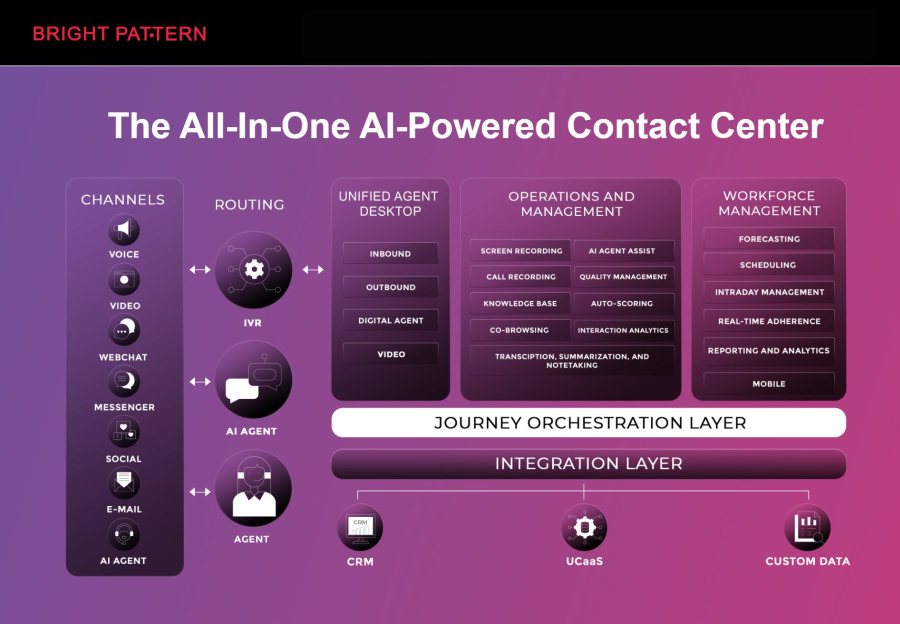
Platforms like Bright Pattern’s AI call center combine all these capabilities into cloud-based, omnichannel solutions. They integrate with CRM and helpdesk systems to give agents and managers a complete, unified view of every customer interaction.
Top AI Call Center Software to consider
If you’re evaluating AI call center solutions, it helps to see how the leading platforms stack up. Here’s a list of some of the most widely recognized providers today:
1. Bright Pattern
Bright Pattern is a cloud-native, omnichannel AI call center platform designed for seamless customer experiences across voice, chat, email, and messaging apps. It combines advanced conversational AI, real-time agent assistance, and predictive routing to ensure faster resolutions and higher customer satisfaction. Bright Pattern’s low-code design tools allow businesses to customize workflows without heavy IT involvement, while integrations with leading CRMs and helpdesk systems deliver a unified view of every customer interaction. Real-world deployments show measurable improvements in first-call resolution, agent efficiency, and overall CX, making it a top choice for organizations aiming to modernize their contact centers.
2. Genesys Cloud CX
Genesys offers AI-powered omnichannel customer engagement with predictive routing, virtual agents, and workforce optimization tools. Its cloud-native architecture supports scalable deployments across multiple channels.
3. Five9
Five9 provides AI-driven call center solutions with intelligent routing, virtual agents, and real-time analytics. Its platform emphasizes ease of integration with CRM systems and focuses on improving agent productivity.
4. NICE inContact
NICE inContact offers AI-enhanced customer interactions, blending human agents with virtual assistants. Features include workforce management, omnichannel routing, and customer analytics.
5. Talkdesk CX Cloud
Talkdesk delivers AI-powered automation, real-time reporting, and voice and digital channel support. Its AI Assist feature helps agents respond faster and resolve more interactions efficiently.
6. Twilio Flex
Twilio Flex is a fully programmable cloud contact center platform that allows businesses to embed AI capabilities, automate workflows, and provide seamless omnichannel experiences.
7. Amazon Connect
Amazon Connect leverages AWS AI services for voice and chat interactions. It offers scalable cloud infrastructure and integrates with machine learning models to deliver personalized, intelligent routing and self-service options.
8. Zendesk Sunshine Conversations
Zendesk’s platform uses AI to unify customer data and automate interactions across messaging channels. Its focus is on contextual engagement, analytics, and improving first-contact resolution
Core Technologies Powering AI Call Centers
Several key technologies work together behind the scenes to enable AI-driven contact centers.
Natural Language Processing (NLP)
NLP allows AI systems to understand human language in both text and speech. It powers capabilities such as:
- Understanding questions expressed in different ways.
- Extracting entities like names, dates, and account numbers.
- Identifying customer intent (for example, cancellation vs. upgrade).
- Supporting multilingual conversations across global audiences.
Machine Learning (ML)
Machine learning models learn from historical interaction data to improve over time. In an AI call center, ML is used to:
- Predict the best responses based on previous successful interactions.
- Optimize routing rules for higher FCR and lower handling time.
- Identify patterns in customer behavior and recurring issues.
- Detect anomalies and potential compliance risks.
Speech Recognition and Speech Analytics
Automatic speech recognition (ASR) converts voice to text, enabling AI to process calls much like chat.Speech analytics then analyzes the content and tone of the conversation to detect keywords, emotions, and trends.
This enables:
- Smarter IVR and voicebots that understand natural speech.
- Real-time detection of frustration or urgency.
- Post-call quality monitoring on 100% of calls, not just small samples.
Conversational AI
Conversational AI orchestrates context-aware dialogs across channels. It combines NLP, ML, and business rules so virtual agents can:
- Hold multi-turn conversations that feel natural and human-like.
- Remember context as customers move from chat to voice or email.
- Ask clarifying questions to reach accurate resolutions.
- Escalate gracefully when a human agent is needed.
Business Benefits of AI Call Center Solutions
Implemented thoughtfully, AI call center solutions deliver measurable benefits across operations, customer experience, and employee engagement.
1. 24/7 Availability Without Extra Headcount
Virtual agents never sleep. They can provide round-the-clock self-service for common tasks like checking order status, resetting passwords, scheduling appointments, and answering FAQs. Customers get instant help at any time, in any time zone, even during holidays or peak periods.
2. Faster Response Times and Shorter Queues
AI can handle thousands of concurrent interactions simultaneously, eliminating bottlenecks that delay service. Routine issues are resolved instantly through self-service, while intelligent routing directs more complex queries to the best available human agent, cutting down wait times and abandonment rates.
3. Lower Operational Costs
By offloading repetitive, low-complexity work to AI, organizations can:
- Reduce staffing and overtime needs for basic support.
- Shorten training cycles by simplifying agent workflows.
- Improve resource utilization during spikes and slowdowns.
Instead of increasing headcount to maintain service levels, businesses can scale digitally, keeping costs in check as volumes grow.
4. Consistent, High-Quality Customer Experience
Unlike humans, AI does not forget scripts or overlook steps. Well-designed AI call center flows deliver consistent, policy-compliant experiences on every interaction. Combined with quality monitoring and analytics, this raises overall service quality while still allowing agents to add a human touch where it matters most.
5. Enhanced Personalization and Relevance
When integrated with CRM, order management, and helpdesk systems, AI can access real-time customer context such as:
- Purchase and interaction history.
- Open cases and previous resolutions.
- Preferences, language, and communication channels.
This allows AI and agents to deliver highly personalized, context-aware interactions, such as proactively surfacing relevant knowledge, recommending the next best action, or tailoring offers to the individual.
6. Higher Agent Productivity and Satisfaction
AI does not just help customers; it also acts as a digital co-pilot for your team. Agent-assist capabilities can:
- Suggest responses and knowledge articles in real time.
- Auto-summarize calls and generate after-call notes.
- Flag potential cross-sell or upsell opportunities.
Real-world deployments report around 25% better agent efficiency, as agents spend less time searching systems and performing manual tasks, and more time having meaningful conversations.
7. Improved First-Call Resolution and CSAT
By combining smart routing, knowledge-driven assistance, and complete customer context, AI call center solutions help more issues get resolved in a single interaction. Many organizations see approximately 30% improvement in first-call resolution, which drives higher satisfaction, loyalty, and lifetime value.
Practical Use Cases Across the Customer Journey
AI can add value at every stage of the customer lifecycle, from pre-sales inquiries to ongoing support and retention.
Pre-Sales and Onboarding
- Handling product questions across web chat and messaging apps.
- Guiding customers through pricing, configuration, and eligibility checks.
- Scheduling demos, callbacks, or appointments without human involvement.
- Qualifying leads before transferring them to sales teams.
Account and Order Management
- Checking order status, shipping details, or appointment times.
- Updating account information and preferences securely.
- Processing simple changes, such as renewals or plan upgrades.
Technical Support and Troubleshooting
- Guiding customers through step-by-step troubleshooting flows.
- Collecting diagnostic information before routing to a specialist.
- Using predictive intelligence to recommend fixes based on similar cases.
Billing, Payments, and Collections
- Answering common billing questions and explaining charges.
- Automating secure payment processing within IVR or chat.
- Sending proactive reminders about due dates or expiring cards.
Customer Retention and Loyalty
- Detecting churn signals through sentiment and behavior analysis.
- Triggering personalized retention offers or outreach.
- Capturing feedback via post-interaction surveys and recommendations.
What to Look For in an AI Call Center Platform
Not all AI call center solutions are created equal. When evaluating platforms, including options like Bright Pattern's AI-powered contact center, prioritize capabilities that support omnichannel, data-driven customer service today and set you up for next-generation CX tomorrow.
1. True Omnichannel Support
Your AI solution should orchestrate seamless conversations across:
- Voice and telephony.
- Web and in-app chat.
- Email and ticketing.
- SMS and messaging channels.
- Social and emerging channels as your strategy evolves.
Customers should be able to switch channels without losing context, and agents should see the full interaction history in a single view.
2. Deep CRM and Helpdesk Integration
For meaningful personalization and efficient workflows, your AI call center needs to integrate with your existing systems, such as:
- Customer relationship management (CRM) platforms.
- Helpdesk and ticketing tools.
- Knowledge bases and self-service portals.
- Back-office and line-of-business applications when relevant.
Look for out-of-the-box connectors, open APIs, and low-code integration capabilities so you can unlock data quickly without lengthy custom projects.
3. Robust Data Privacy, Security, and Compliance
AI solutions handle sensitive customer data, so privacy and compliance must be built in from day one. Evaluate platforms on their ability to support regulations such as:
- GDPR for customers in the European Union.
- CCPA and related state or regional privacy laws.
- HIPAA and similar frameworks for protected health information where applicable.
Essential features include strong encryption, granular access controls, audit trails, consent management, and secure data retention practices.
4. Real-Time Analytics and Insightful Reporting
Modern AI call center software should provide real-time dashboards and historical analytics covering:
- Volumes, wait times, and handling times across channels.
- First-contact resolution, transfer rates, and escalations.
- Customer sentiment and NPS or CSAT trends.
- Agent productivity and coaching opportunities.
These insights help you fine-tune automation flows, refine scripts, and optimize workforce management on an ongoing basis.
5. Multilingual Capabilities
If you serve a global audience, choose a platform with robust multilingual support across both speech and text channels. This can include:
- Understanding and responding in multiple languages.
- Language detection and routing to the right agent or bot.
- Localized content management and translation workflows.
6. Scalable Cloud Infrastructure
Cloud-native AI call center platforms provide the agility and resilience modern operations demand. Look for:
- Elastic scaling to handle seasonal spikes and rapid growth.
- High availability and built-in redundancy.
- Global reach with regional hosting options when required.
- Continuous updates and feature releases without heavy IT overhead.
7. Flexible, Configurable Automation
Your team should be able to design and adjust AI flows without constantly relying on developers. Low-code conversation builders, reusable components, and A/B testing capabilities make it easier to iterate toward the best customer experiences.
Data Privacy, Security, and Compliance by Design
Trust is at the core of every customer interaction. Because AI call center solutions process large volumes of customer data and conversation transcripts, data protection must be more than an afterthought.
When assessing a vendor, confirm that they:
- Encrypt data in transit and at rest.
- Provide fine-grained role-based access controls.
- Offer clear data residency and retention options.
- Support privacy-by-design principles and regular security audits.
For regulated industries such as healthcare, finance, and public sector organizations, ensure the platform can be configured to support compliance obligations like HIPAA, PCI-related processes, and local data protection rules.
Balancing Automation with the Human Touch
One of the most critical success factors in AI call center deployments is striking the right balance between automation and human interaction. Customers appreciate speed and convenience, but they also value empathy and nuanced understanding.
Leading organizations design experiences where:
- AI handles routine tasks end to end, such as FAQs and status checks.
- AI supports agents with real-time suggestions and knowledge, rather than replacing them.
- Seamless handoffs allow customers to move from bot to human without repeating information.
- Customers keep control, with clear options to escalate to a person when they prefer.
Agent training also evolves. With AI taking care of repetitive work, human agents can focus on higher-value conversations that require emotional intelligence, negotiation, and creative problem solving.
Monitoring Accuracy and Model Drift
AI is not a set-and-forget technology. Customer language, products, and policies change over time. To maintain high-quality experiences, you need a plan to monitor and improve your AI models continuously.
Best practices include:
- Tracking containment rates and escalation reasons for virtual agents.
- Reviewing misclassified intents and updating training data regularly.
- Monitoring changes in sentiment or resolution metrics that might signal model drift.
- Involving subject-matter experts in reviewing and refining AI behavior.
Platforms like Bright Pattern support ongoing tuning with detailed analytics and feedback loops, helping your AI become more accurate and resilient as it learns from real interactions.
Measuring Impact: KPIs and Real-World Results
To build a solid business case and demonstrate value, define clear KPIs before launching your AI call center initiatives. Common metrics include:
- First-call resolution (FCR) and first-contact resolution across channels.
- Average handle time (AHT) and total time to resolution.
- Agent efficiency and interaction capacity per agent.
- Customer satisfaction scores such as CSAT or NPS.
- Self-service containment rate for virtual agents and IVR.
- Cost per contact and overall operating cost trends.
Organizations that deploy AI thoughtfully often see around 25% improvement in agent efficiency and 30% gains in first-call resolution, alongside higher satisfaction levels and reduced costs. Quantifying these improvements helps secure executive support and guides further investment.
Implementation Roadmap: From Pilot to Scale
A structured rollout maximizes the upside of AI call center solutions while minimizing risk. Consider this phased approach:
1. Define Vision and Use Cases
- Clarify your objectives: cost reduction, CX improvement, revenue growth, or all of the above.
- Identify high-impact, low-risk use cases (for example, FAQs, status checks, simple changes).
- Align stakeholders across customer service, IT, compliance, and the business.
2. Select the Right Platform
- Evaluate omnichannel support, CRM and helpdesk integration, and cloud scalability.
- Validate security, privacy, and compliance capabilities.
- Ensure the platform offers real-time analytics and easy-to-use design tools.
3. Design Customer-Centric Journeys
- Map customer journeys and pain points across channels.
- Define where automation adds value and where human touch is essential.
- Design clear escalation paths to live agents with full context transfer.
4. Launch a Focused Pilot
- Start with a limited set of intents and channels.
- Monitor performance daily using your defined KPIs.
- Collect customer and agent feedback to refine flows.
5. Optimize and Scale
- Expand to additional intents, languages, and channels based on results.
- Continuously improve models to avoid accuracy issues or drift.
- Integrate more deeply with back-end systems for richer personalization.
The Future of AI Call Centers: Generative, Hyper-Personal, Emotion-Aware
AI call center technology continues to evolve rapidly. Looking ahead, several trends are poised to unlock even greater value.
Generative AI for Richer Conversations
Generative AI can synthesize natural, context-aware responses, summaries, and knowledge articles in real time. In call centers, this helps:
- Compose dynamic replies that match brand voice and policy.
- Auto-generate call summaries, follow-up emails, and case notes.
- Extend knowledge bases by proposing new content based on emerging issues.
Hyper-Personalization at Scale
As AI platforms ingest more behavioral and interaction data, they can move beyond basic personalization to hyper-personalized experiences. This can include:
- Predicting why a customer is contacting you before they explain.
- Prioritizing and routing based on customer value and urgency.
- Tailoring offers, messages, and resolutions to each individual.
Emotion-Aware and Empathy-Driven Interactions
Advances in sentiment analysis and speech emotion recognition will allow AI to better detect how customers feel, not just what they say. Emotion-aware capabilities can:
- Flag high-risk or highly emotional situations in real time.
- Trigger proactive supervisor assistance for sensitive calls.
- Coach agents on tone and phrasing to increase empathy.
These innovations will help AI call centers deliver experiences that are not only efficient, but also deeply human in how they respond to customer emotions.
How Bright Pattern Fits Into Your AI Call Center Strategy
Platforms like Bright Pattern's AI call center solutions are designed to bring all these elements together in a practical, deployable way. Built on scalable cloud infrastructure and focused on omnichannel customer journeys, Bright Pattern helps organizations:
- Automate voice, chat, email, and messaging interactions with conversational AI.
- Integrate seamlessly with leading CRM and helpdesk systems.
- Provide 24/7 self-service and intelligent routing for faster, consistent outcomes.
- Empower agents with real-time assistance, sentiment insights, and analytics.
- Maintain strong data privacy and regulatory alignment.
With proven improvements in agent efficiency and first-call resolution from real-world deployments, Bright Pattern offers a practical path to modernizing your contact center with AI while keeping the customer firmly at the center of every decision.
Conclusion: Turning Your Call Center into a Strategic AI-Powered Asset
AI call center solutions are no longer experimental add-ons. They are becoming the foundation of high-performing customer service operations, enabling organizations to deliver faster, more personalized, and more emotionally intelligent support at scale.
By combining conversational AI, NLP, machine learning, speech recognition, and robust analytics, you can:
- Cut response times and wait times dramatically.
- Boost agent productivity and job satisfaction.
- Raise first-call resolution and customer satisfaction scores.
- Control costs while scaling to meet rising customer expectations.
The key is to choose a platform that offers omnichannel integration, strong privacy and compliance, real-time insights, multilingual capabilities, and cloud scalability, while balancing automation with seamless human handoffs and ongoing model management.
Organizations that embrace AI-powered call centers today are positioning themselves for a future where generative, hyper-personalized, emotion-aware experiences define what great customer service looks like. With the right strategy and solutions, your contact center can evolve from a cost center into a powerful, AI-driven engine for customer loyalty and growth.
